
Public spaces
Stairwell indirect lighting
A stairwell is an apartment block’s calling card and a safety space at the same time. Indirect light as a wall line following the stairs makes a hard concrete shaft soft – and it cannot be broken with a ball.

A stairwell is different from a staircase at home
In a staircase at home the steps are lit. In an apartment block stairwell the space is lit: three to eight floors, a windowless shaft, hard surfaces, hundreds of users a day. The requirements come from building regulations and the housing company’s decision, not from interior taste. And the luminaire must last – both 4,000 hours a year and vandalism.
Indirect light suits this for three reasons: it does not dazzle people moving on the stairs, it visually softens hard surfaces, and a strip in a profile at the ceiling edge is out of reach.
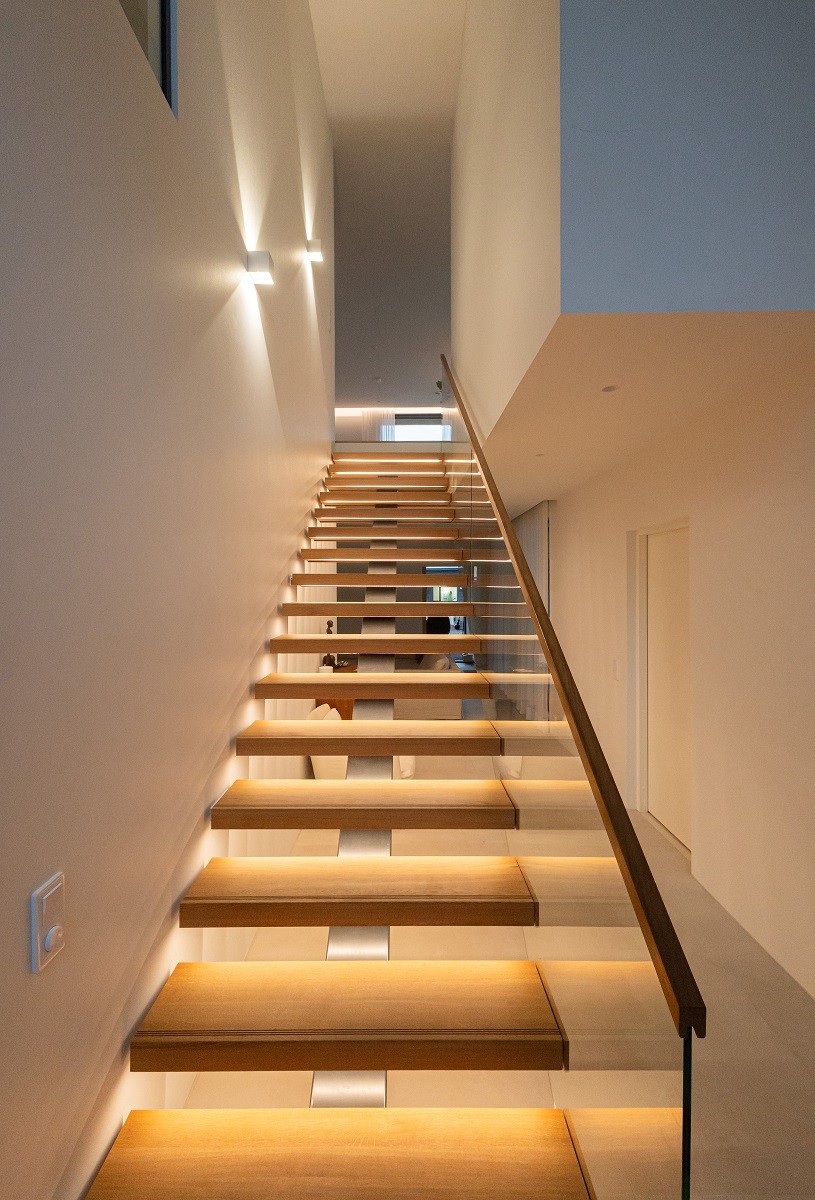
Three placement options
1. Wall line following the stairs – recommended
A corner profile or two-directional wall profile on the outer wall at 1.8-2.2 m height, following the rise of the stairs. Light up to the ceiling and down onto the steps. A continuous line through the whole stairwell – it leads the eye and makes the space continuous. A height of 2 m keeps the profile out of reach.
In practice: a 4-storey stairwell, 3.2 m storey height
Stair rise 4 × 3.2 = 12.8 m, horizontal run with landings about 20 m → a sloping line of about 25 m of strip. Two-directional profile, SMD 14.4 W/m, 5-year warranty = 346 W → four 150 W DALI drivers, one per landing behind an access hatch. A motion sensor on every floor: base level 20 %, movement raises it to 100 % for 3 minutes. Materials about €3,000, control €600.
2. Under the steps – safety
Strip under the front edge of every landing and flight of steps, light down. It lights exactly the surface you step on. Requires concrete or steel stairs with an underside the profile can attach to. Combined with the wall line, not on its own. The challenge with this method is that stairs usually arrive as prefabricated elements, so it must be taken into account already in the element design. In public spaces retrofitting to steps rarely works well.
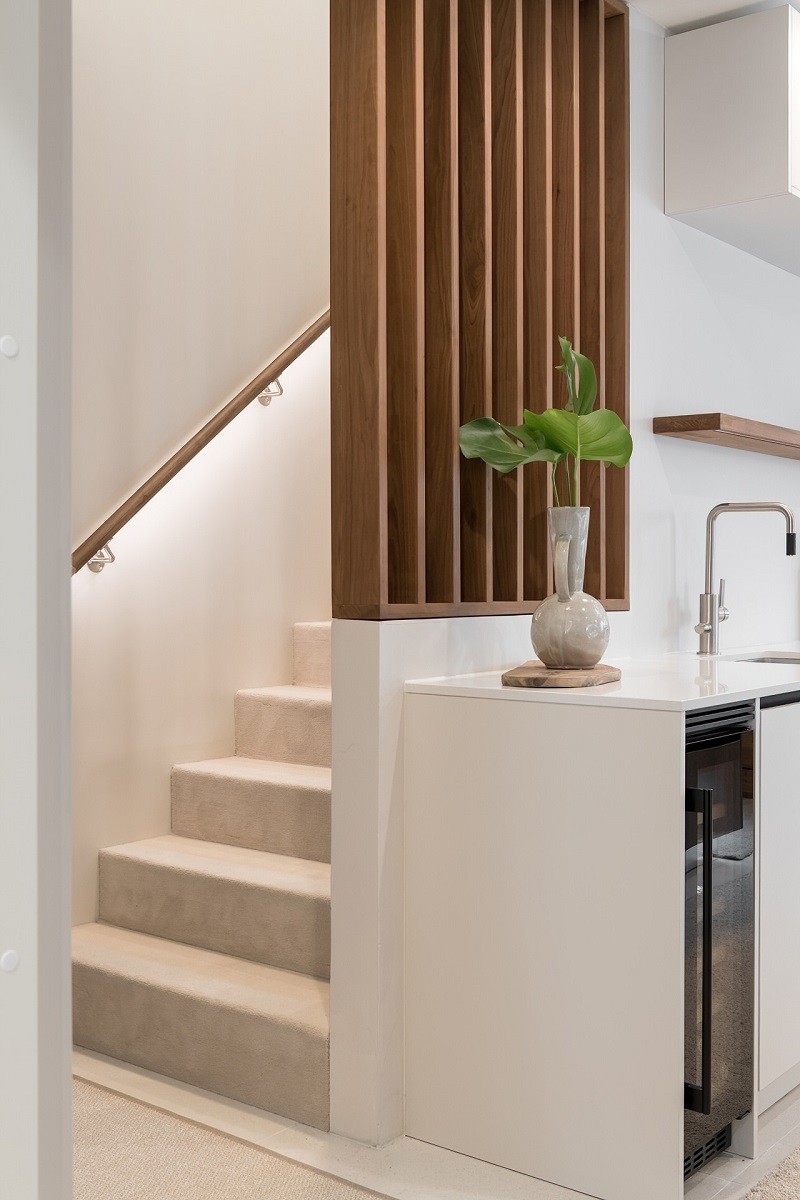
3. Under the handrail
Strip on the underside of the handrail, light down onto the steps. The handrail must suit a profile. Works in new builds when the handrail is designed for the light.
Requirements
| Requirement | Value | Source |
|---|---|---|
| Illuminance on the steps | ≥ 100 lx | Building regulations, accessibility |
| Uniformity | No dark spots between flights of steps | Fall risk – varying light makes edges unclear |
| Emergency lighting | Separate, battery-backed | Rescue Act – indirect light does not replace it |
| Operating hours | 3,000-4,000 h/yr | Base level continuously, movement raises it |
| Vandal resistance | Strip above 2 m or profile with a lockable cover | Housing company experience |
| Warranty | 5-7 yrs | Replacement in a stairwell needs scaffolding |
Emergency lighting is separate
Indirect light is general lighting. It does not replace the emergency escape lighting required by law, which must work on battery during a power cut. They are two systems – indirect light makes the space pleasant, emergency lighting makes it compliant.
Control – motion sensing floor by floor
A stairwell is never dark – a base level of 10-20 % burns continuously, so the space does not feel abandoned and the camera can see. A motion sensor on every landing raises the light to 100 % when someone arrives, and it follows the walker floor by floor. Three-minute delay. In a DALI system this is programming; Zigbee works in a smaller building.
The energy saving between base level and movement is 60-70 % compared with continuous full light – that is the figure that decides the matter at the housing company meeting.
| Strip | 14.4 W/m SMD, CRI 90+, 5-year warranty |
| Profile | Two-directional wall profile at 2 m height, or corner profile at the ceiling edge |
| Colour temperature | 3000-3500 K – warmer than an office, cooler than a home |
| Driver | DALI or Zigbee, one per landing, behind an access hatch |
| Control | Base level 15 %, movement 100 % for 3 min, sensor per floor |
| Emergency lighting | Separate battery-backed system |
Staircase at home → · Wall mounting → · For architects – standards →
Housing company stairwell → LedStore
Frequently asked questions
How is indirect lighting done in a stairwell?
A two-directional wall profile at 2 m height following the stairs, light up to the ceiling and down onto the steps. A continuous line through the whole stairwell. A height above 2 m keeps it out of reach.
Is indirect light suitable for a housing company stairwell?
Yes, but it needs a decision by the general meeting and an electrical plan. It is general lighting and does not replace battery-backed emergency lighting – they are two systems.
How much light for a stairwell?
At least 100 lx on the steps. Uniformity matters more than quantity – dark spots between flights of steps are a fall risk.
Which strip for a stairwell?
A long-warranty strip: SUPREME 7 years, thicker copper base. There are 3,000-4,000 operating hours a year, and replacement in a stairwell needs scaffolding.
How is stairwell lighting controlled?
Base level 15 % continuously, a motion sensor on every floor raises it to 100 % for three minutes. A saving of 60-70 % compared with continuous full light.
Can an LED strip withstand vandalism in a stairwell?
When the profile is above 2 m or at the ceiling edge, nobody can reach it. A strip under the handrail is within reach – it only suits a supervised space.
Toteutettuja kohteita
Epäsuora valo portaissa
Käsijohteen alapinta, askelmien reunat ja sivuseinän valolinja – turvallisuusvaloa joka näyttää hyvältä.
Kuvat: LedStore.fi toteutetuista kohteista.