
Epäsuoravalo.fi
Indirect lighting for low ceilings – under 220 cm
Indirect light for low ceilings: standalone wall profile 17 mm, flat 24 mm, curtain profile 29 mm. Even slimmer ones inside a plasterboard structure. All dimensions.

The challenge of a low ceiling
When the ceiling is already low or building services eat into ceiling height, building indirect light calls for precise sizing. The deciding question is whether you build a structure or not: a surface-mounted wall profile is ready as it is and takes 17 mm, while plaster-in and bulkhead profiles are slimmer but need framing and plasterboard around them.
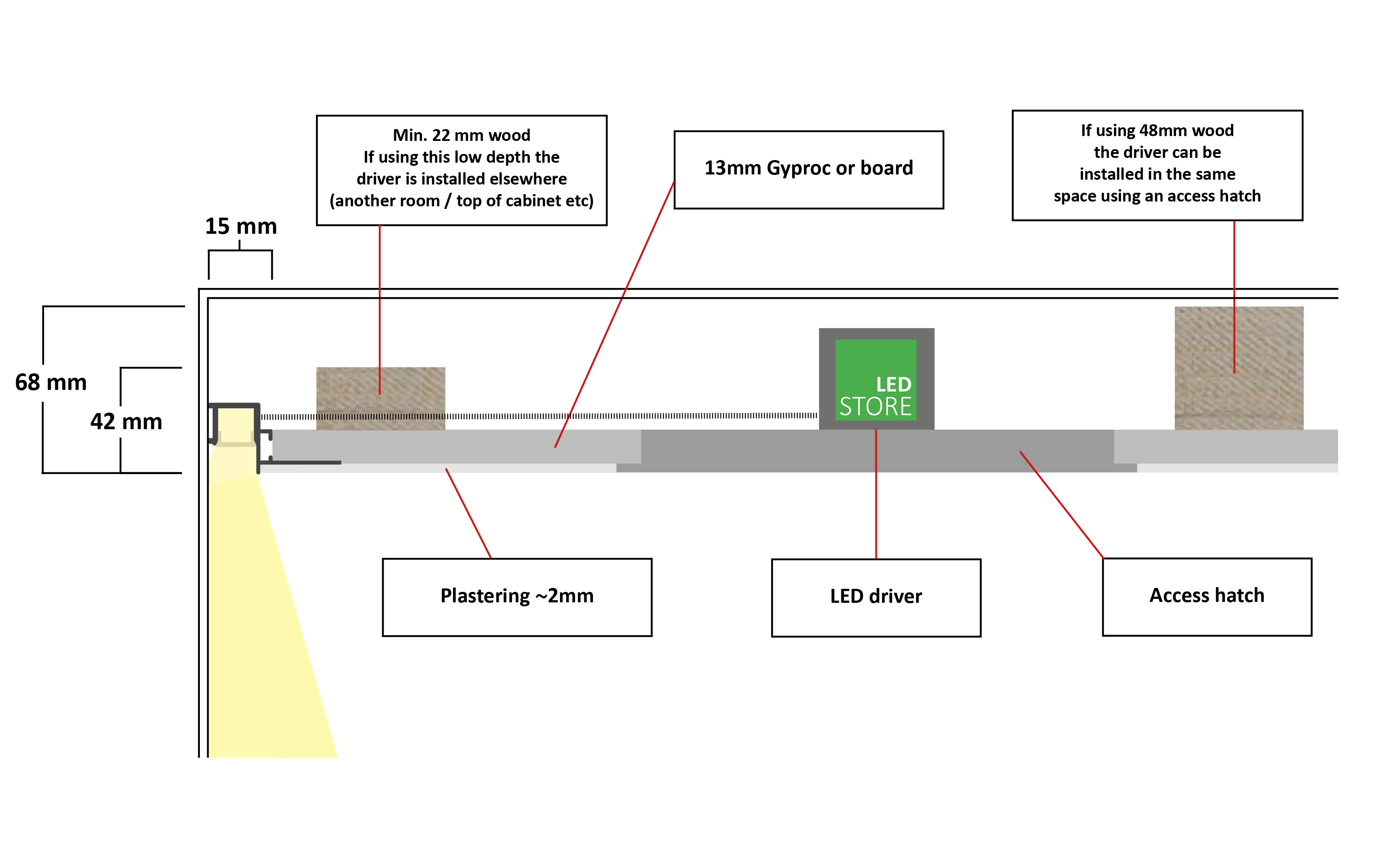
The biggest problem in a low room is not lack of space – it is the glare shield. The lower the structure, the shorter the glare shield, and the more likely the strip is directly visible. That is why a COB strip (dotless) is chosen for a profile under 20 mm; in a deeper profile dense SMD also works.
Solutions – from the smallest space required
Of the standalone profiles aimed at the ceiling, the smallest is a 50 mm high two-way wall profile. The surface-mounted range falls between 50-60 mm – all can be installed on a finished wall without demolition.
Plaster-in models are slimmer, but their figure only states the depth of the light surface, not the space required by the whole structure. Below, the range with dimensions, prices and product links.
Why a COB strip is essential in a profile under 20 mm
The deciding dimension is the profile depth from strip to diffuser. In a profile under 20 mm, the dots of an SMD strip have no distance to blend and they stand out. Today’s SMD strips are already dense, so in a profile over 20 mm they also give an even line. COB (Chip on Board) is dotless at every depth.
| SMD under 20 mm | Dot pattern on the ceiling |
| COB under 20 mm | Even line of light |
| SMD over 20 mm | Works – the dots blend |
| Max power in low profiles | 14.4 W/m |
Power over 14.4 W/m significantly shortens lifetime in low profiles – the temperature rises because the cooling surface is small. Limit the strip in a low profile to 14.4 W/m.
Strips and accessories for low ceilings
Strips and accessories → LedStore
Strips and accessories → LedStore
Frequently asked – low ceilings
What is the absolute minimum height?
It depends on whether you build a structure. Without building work, the lowest profile lighting the ceiling or wall is a 49 mm two-way wall profile, ready as it is. If you build a board structure, the SHELF PROFILE is only 10 mm thick, so the minimum board depth is 10 mm – but then the space required is set by the framing, not the profile.
Why does the light show dots in a low structure?
The profile is too shallow: at a depth under 20 mm, the dots of an SMD strip have no distance to blend. Switch to a COB strip or use a deeper profile. In a profile over 20 mm, today’s dense SMD works well.
Is a low structure suitable for general lighting?
Yes, but it needs enough power. A 14.4 W/m COB strip on a white ceiling gives enough general light in a normal-height room. For a dark ceiling or a high room, add power or use several lines of light. Not all low profiles can take powerful strips.
Why must power be limited in low profiles?
The cooling surface is small and the heat cannot escape quickly enough. Power over 14.4 W/m in a closed low profile shortens the strip’s life from 50 000 hours to 10 000-20 000 hours.
The difference between a ceiling Z-profile and a wall profile?
A Z-profile is fixed to the ceiling and the light goes down against the wall. A wall profile is fixed to the wall, either on the wall or near the ceiling, and the light goes down or up. A low Z takes about 20 mm, a wall profile about 40 mm. The IP44 wall profile also suits bathrooms.
Is adjustable colour temperature worth it?
Yes, especially for a low room. In a low structure glare is a bigger risk, and a warm tone (2700-3000 K) reduces the sense of glare. A CCT strip gives both: neutral for task light, warm for mood. CCT LED strips →
Toteutettuja kohteita
Epäsuora valo matalassa tilassa
7 × 18 mm profiili kyljellään kattoa vasten ja kulmaprofiili katon rajassa – ratkaisuja kun korkeutta ei ole.
Kuvat: LedStore.fi toteutetuista kohteista.