
Design
Colour temperature in indirect lighting
The same strip looks neutral on a white ceiling and yellowish on wood panelling. In indirect light the reflecting surface colours the light – and that has to be considered before the strip is chosen.

What colour temperature means in practice
The Kelvin figure tells you whether white light is warm or cool. 2700 K is the yellow of an incandescent bulb, 4000 K neutral daylight on a cloudy day, 6500 K cold blue. The figure is the tone of the light leaving the lamp – but in indirect lighting you do not see the lamp, you see the surface the light reflects from. And the surface changes the tone.
This is the special feature of indirect lighting that direct-lighting guides ignore: the same 3000 K strip gives a different colour on a different ceiling.
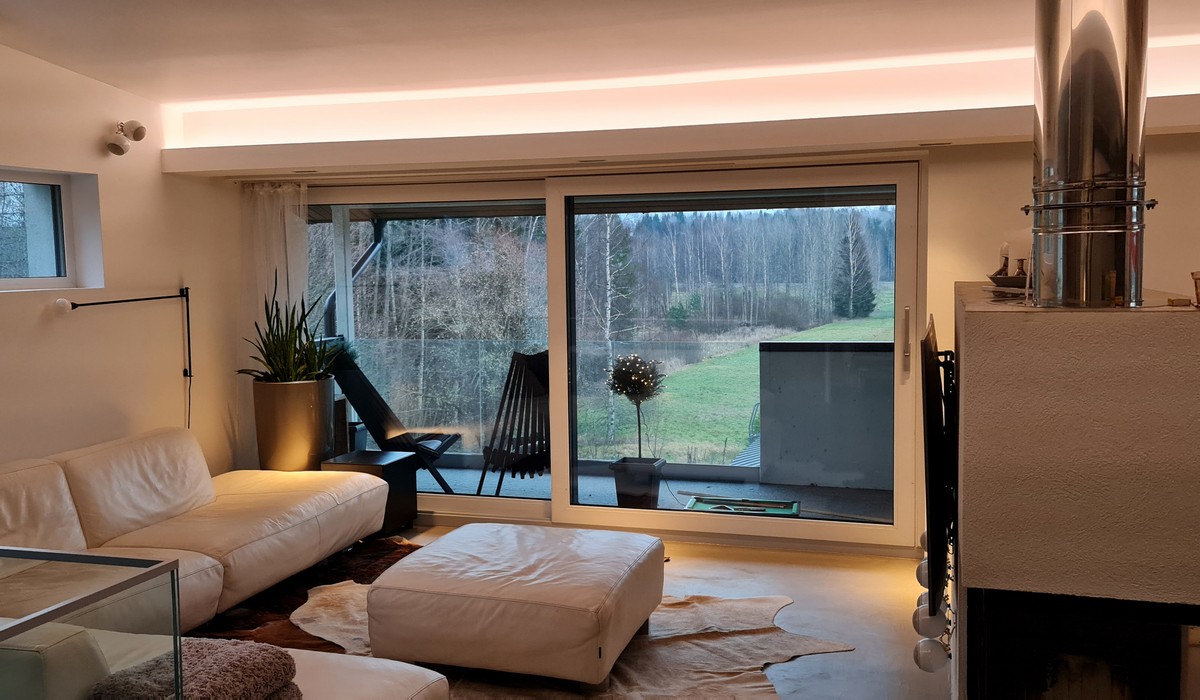
The reflecting surface colours the light
| Ceiling surface | Change | A 3000 K strip looks like | Correction |
|---|---|---|---|
| White matt | No change | 3000 K | Choose the tone you want directly |
| Light grey | Slightly cooler | 3100-3200 K | Not needed |
| Pine, light wood | Noticeably warmer | 2500-2700 K | Choose a 3500-4000 K strip, or CCT |
| Dark wood, brown | Much warmer and dim | Under 2500 K | CCT strip at 4000-5000 K, or paint the ceiling |
| Beige, cream | Warmer | 2700-2800 K | Choose 3500 K |
In practice: log cabin, pine-panelled ceiling, living room
The client wants “warm but not yellow” light. A direct-lighting guide would say 3000 K. The pine panelling warms it to 2600 K – that is orange. The right choice: a 4000 K strip (or 3500 K, which is hard to find), which after reflecting off the panelling looks like 3200-3400 K – warm but not yellow. Or a 2700-6500 K CCT strip, so the tone can be adjusted on site to how it actually looks on the panelling.
Recommendations by room – for indirect light
The figures are the strip’s colour temperature for a white ceiling. For wood panelling, add 700-1000 K.
| Room | Colour temperature | Why |
|---|---|---|
| Living room | 2700-3000 K | Relaxation, warm skin tone, wood and textiles look good |
| Bedroom | 2700 K or warmer | Melatonin – cool light hinders sleep. 2200 K as a night light |
| Kitchen | 3000-3500 K | Food looks appetising but colours stay distinct |
| Bathroom | CCT 2700-4000 K | Cool at the mirror in the morning, warm for a bath in the evening – same room, different task |
| Utility room | 3500-4000 K | Stains and colours show – warm light hides dirt |
| Hallway | 3000 K | Same as the adjoining living space – a tone change at the door looks like a mistake |
| Office | 4000 K | Alertness, neutral, not tiring |
| Sauna | 2200-2700 K | Candlelight – cool feels clinical |
One tone per view
Two different colour temperatures in the same view always look like a mistake – a warm living room and a neutral kitchen in an open-plan space, or 3000 K above the wall cabinets and 4000 K below. The rule: everything visible from one spot, the same tone. In different rooms the difference does not matter.
Exception.
Mood lights can be warm (pendants, night lights, etc.), since their purpose is precisely to create warmth in the space regardless of the general lighting tone. So you can use 4000-6000 K as general lighting in a living-kitchen area, while the pendant over the dining table is 3000 K.
CCT – tunable white
A CCT strip has two rows of LEDs, warm 2700 K and cold 6500 K, and adjusting their ratio changes the tone steplessly. It costs about 50 % more than a fixed one and needs a two-channel driver. It is worth it in three situations:
- A room with two roles: bathroom (morning/evening), a living room also used for work, a kitchen that is also the dining area.
- The reflecting surface is uncertain: wood panelling, a coloured ceiling, or the ceiling has not been decided yet. With CCT the tone can be adjusted on site according to the result.
- Daily rhythm: cool in the morning, warm in the evening, automatically. With Zigbee control this is a schedule, not manual work.
Not worth it when the room’s role does not change – kickboard, stairs, sauna. There a fixed 2700 K does the same for less.
CRI – colour rendering is the other figure that decides
CRI tells you how naturally the light renders colours, on a scale up to 100. Kelvin tells you the tone, CRI tells you the quality – and they are different things. A 3000 K strip at CRI 80 makes skin grey and red brown; the same 3000 K at CRI 95 shows colours correctly.
In indirect light CRI matters more than in direct light, because the light reflects off a surface and the colour error compounds. At least CRI 90, 95 for living spaces and mirrors. LedStore’s strips have a CRI of 95-97.
LED strip for indirect lighting → · Dimming and control → · Bathroom – CCT in practice →
CCT strips and drivers → LedStore
Frequently asked questions
Which colour temperature for indirect lighting?
Living room and bedroom 2700-3000 K, kitchen 3000-3500 K, office 4000 K – for a white ceiling. For wood panelling choose 700-1000 K cooler, because wood warms the reflected light.
Why does 3000 K look yellow on a wooden ceiling?
Wood absorbs blue light and reflects warm light. A 3000 K strip reflecting off pine panelling looks like 2500-2700 K. The solution is a 4000 K strip, or CCT so the tone can be adjusted on site.
Is 3000K or 4000K better for the home?
3000 K for living spaces with a white ceiling. 4000 K for the kitchen and utility room, or for living spaces with a wooden ceiling. The same figure on a different ceiling is a different light.
What does CCT mean in an LED strip?
Tunable white: two rows of LEDs, warm and cold, whose ratio sets the colour temperature between 2700-6500 K. Needs a two-channel driver. Worth it when the room has two roles or the reflecting surface is uncertain.
What is CRI and why does it matter?
Colour rendering index, on a scale up to 100. Below 90 makes skin look grey. In indirect light the colour error compounds in the reflection, so at least 90, and 95 for living spaces.
Can different colour temperatures be combined in the same room?
Not in the same view – two tones look like a mistake. In different rooms or at different heights the difference does not matter and can be intentional: warm living light, neutral task light.