
Products
LED neon in indirect lighting
In a silicone sleeve, the strip becomes a continuous tube of light that bends into a curve. It does not replace the aluminium profile – but it does things a profile cannot.

What LED neon is
LED neon is an ordinary LED strip cast inside a silicone tube. The silicone diffuses the light so the dots disappear and the result is a continuous glowing line – hence the name, it looks like an old neon tube. Unlike a strip in an aluminium profile, LED neon is a visible light element: it is not hidden, it is the thing you look at.
That is why it is the exception in indirect lighting, not the rule. Indirect light is based on a hidden source, and LED neon is the opposite. But there are situations where a profile does not work and neon does.
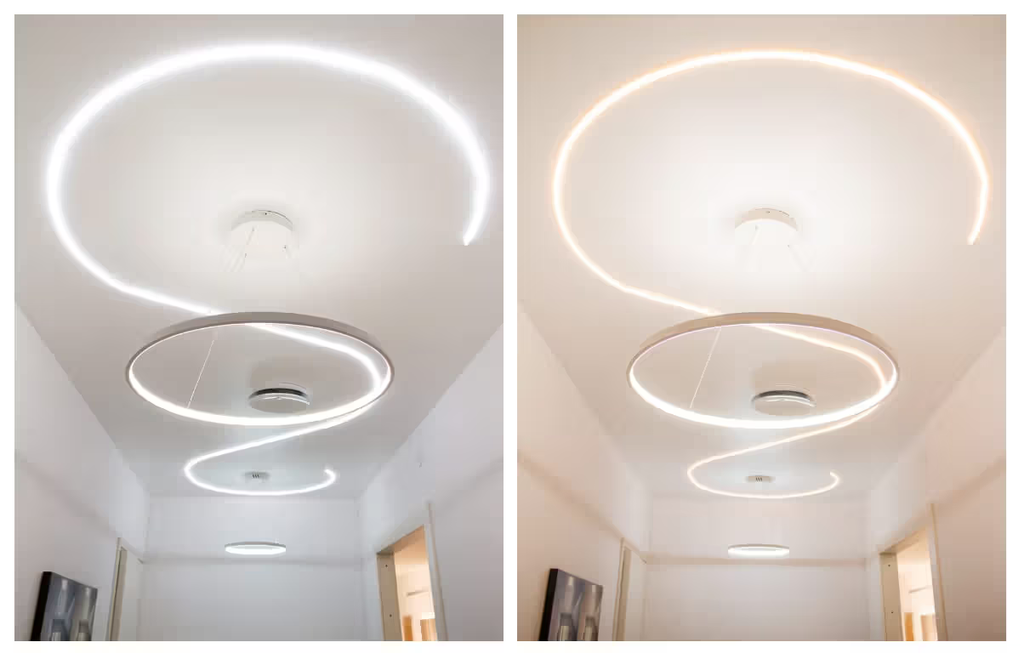
LED neon vs. aluminium profile
| Aluminium profile + strip | LED neon | |
|---|---|---|
| Visibility | Hidden, light reflects off the surface | Visible glowing line |
| Shape | Straight, corners mitred at 45° | Bends into curves, 3-5 cm radius, even 90-degree bends |
| Cooling | Aluminium conducts heat away | Silicone insulates – lower power |
| Power | 7.2-17 W/m | 6-10 W/m |
| Moisture | Depends on the strip’s IP rating | IP65-67 as standard, seamless |
| Fixing | Screws into the profile | Mounting rails or clips |
| Price | €30-50/m | €25-60/m |
| Suits | Wall-ceiling junction, bulkheads, furniture | Curves, outdoor spaces, lettering, accent lines |
When neon is the right choice
1. A curved structure
A round dropped ceiling, a curved wall, the curved handrail of a staircase. An aluminium profile does not bend – the alternative is dozens of short pieces that look like a broken line. LED neon bends at a 3-5 cm radius (even a 90-degree angle!) and follows the curve continuously. Here it is the only workable solution.
In practice: round dropped ceiling, 2.4 m diameter
Perimeter 7.5 m. LED neon 8 W/m = 60 W, an 80 W driver behind an access hatch. Neon on a mounting rail on the inner face of the dropped ceiling’s edge, light up to the ceiling. Because the neon is hidden inside the dropped ceiling, this is genuinely indirect light – the neon simply made the curve possible. Materials about €350.
2. Outdoor spaces and wet locations
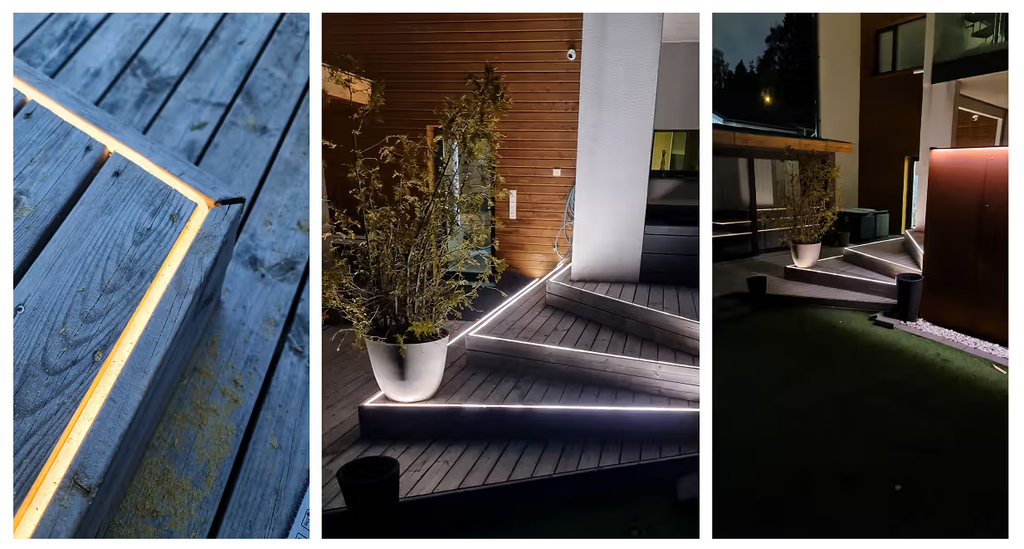
The silicone sleeve is a seamless IP65-67 with no separate connectors. On the edge of a deck, on outdoor stair treads, around a pool. In an aluminium profile the strip ends and joints are always the weak point – neon does not have them.
3. A visible accent line
When the line of light is meant to be a visible part of the interior: a dividing line on a wall, the edge of a bar counter, a shop logo. This is direct light, not indirect, and that is the intention. Neon gives an even line that a profile does not quite achieve even with a diffuser.
Three limitations
- Bends only “sideways”. Standard neon bends sideways. It does not bend against its narrow edge, i.e. up and down, just like a traditional LED strip. So it is best for curved wall surfaces lit from inside the ceiling.
- Power is lower. Silicone insulates heat, so neon’s power is 6-12 W/m. It is just enough for general lighting on a light ceiling, not for wood panelling.
- Cut only at marked points. The cut interval is typically 5-10 cm, and the end has to be sealed with an end cap. The length will not be exact.
Neon is not a shortcut
For a straight wall-ceiling junction an aluminium profile is better: more light, cheaper, precise corners, a choice of glare shield. LED neon is chosen when there is a reason – curved surfaces or moisture. Without a reason it is the weaker choice.
Curved light slot with a profile → · Aluminium profiles → · Outdoor lighting → · Staircase →
LED neon → LedStore
Frequently asked questions
What does LED neon mean?
A silicone-sleeved LED strip that looks like a continuous light tube. It replaces the traditional neon tube and bends into shapes, so it can be made into curves and lettering.
Can LED neon be bent?
Yes, in its plane. The bend radius is typically 3-5 cm. It does not bend against its narrow edge – that needs a separate side-bending model.
Is LED neon suitable for indirect lighting?
It suits curved structures that a profile cannot follow – a round dropped ceiling, a curved wall. When the neon is hidden inside the structure, it is genuinely indirect light. For a straight wall-ceiling junction an aluminium profile is better.
Does LED neon withstand outdoor use?
IP65-67 models do. The silicone sleeve is seamless with no connectors, which is an advantage over an aluminium profile. The ends are sealed with end caps.
Why is LED neon’s power lower?
Silicone insulates heat, aluminium conducts it away. In neon the strip cannot be as powerful or it overheats. In practice 6-12 W/m versus a profile’s 17 W/m.