
Rooms
Indirect lighting in furniture
Bookcase, TV unit, wardrobe, display cabinet. In furniture the strip is seen from half a metre away, so the dots show immediately and cables spoil everything. Here is how to do it right.

Why furniture lighting is different from room lighting
Indirect light at the ceiling edge is seen from three metres away, furniture light from half a metre. That changes everything: LED dots that blend on the ceiling show as a row of dots on a shelf, a profile hidden on the ceiling is at eye level on a shelf, and a cable that runs behind the board on the ceiling is visible on a shelf unless it is planned.
The other difference is the job. Furniture light does not light the room but the furniture and what is in it – book spines, ornaments, clothes. It is accent light, and its power is a third of general light.
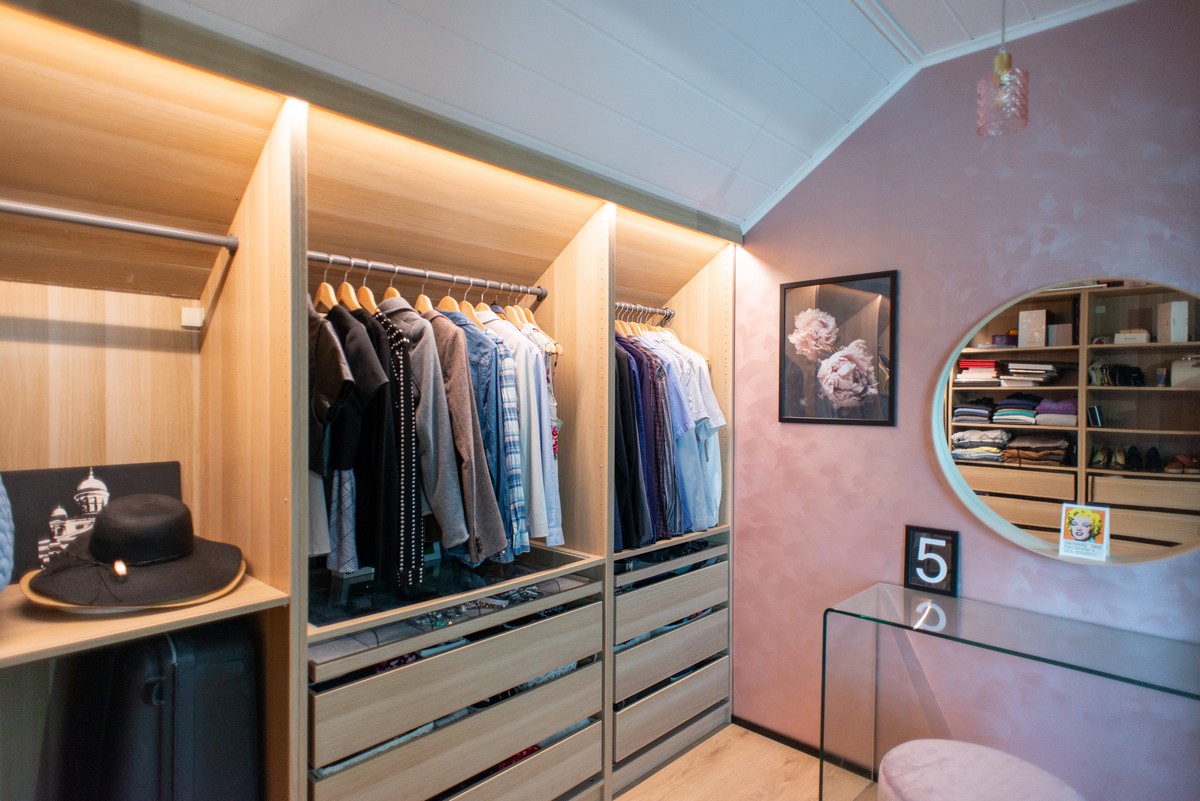
Four ways to place a strip in furniture
1. Front edge of the shelf – light down
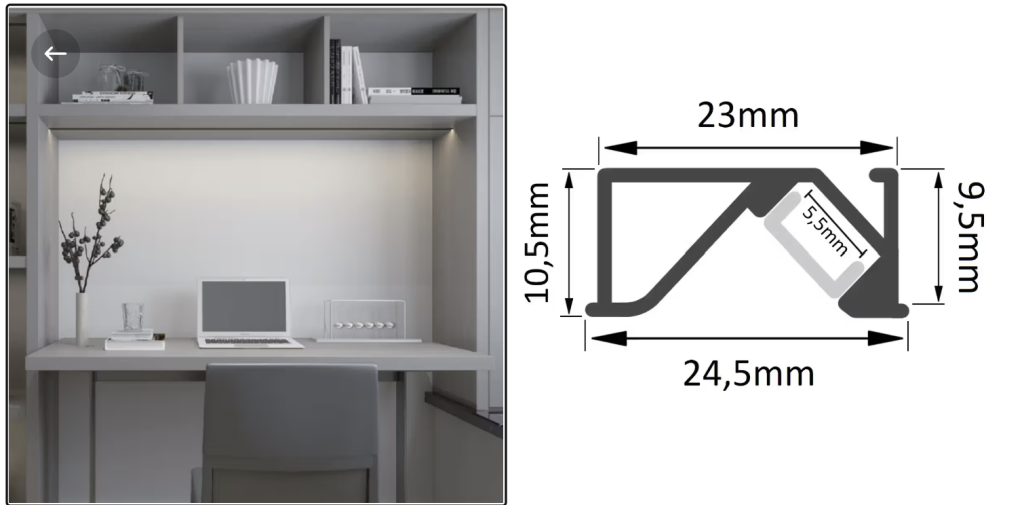
Strip under the front edge of the shelf, light downward. Lights the contents of the shelf below directly. Works in bookcases, open kitchen shelves and wardrobes. A recessed shelf profile needs a 7-10 mm deep groove in the underside of the board – a 16 mm board is enough. Alternatively a clip-on edge profile that grips the board edge without routing, for boards up to 17.5 mm thick.
1.2. Vertical groove along the full height – light onto the inner face
Strip along the full height of the vertical side panels, light inward. It lights every shelf, not just the top ones as happens when the light is only across the top. This is a popular method, so it is included here even though it is not indirect light. It lights well, even the whole room.
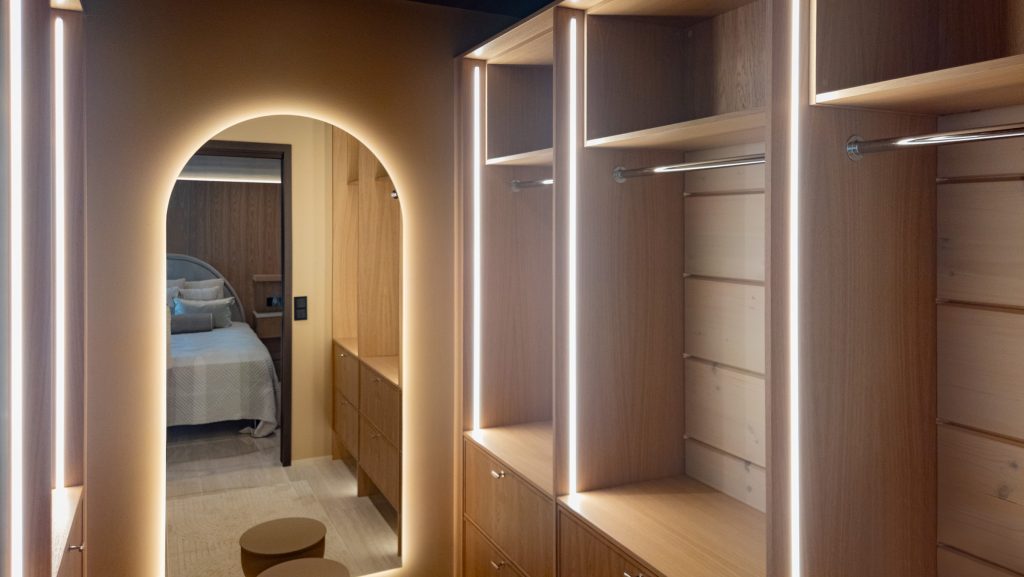
This method works if the profile is swapped for one that lights backwards at an angle rather than straight into the eyes, as in the picture below.
In practice: bookcase, 5 shelves × 90 cm
Strip at the front edge of the top four shelves, the bottom one without. 4 × 0.9 m = 3.6 m of strip at 7.2 W/m = 26 W, driver 36 W. Narrow 5 mm COB strip in a recessed shelf profile. The cables run vertically at the back edge of the bookcase in a cable duct. Materials about €200, driver behind the bookcase in a socket.
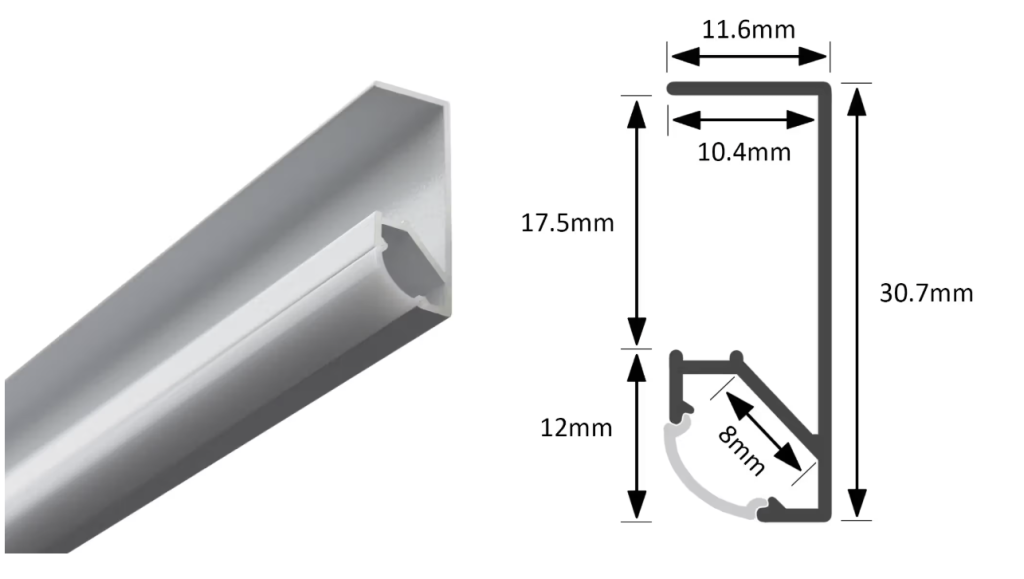
2. Backlight – light onto the back wall
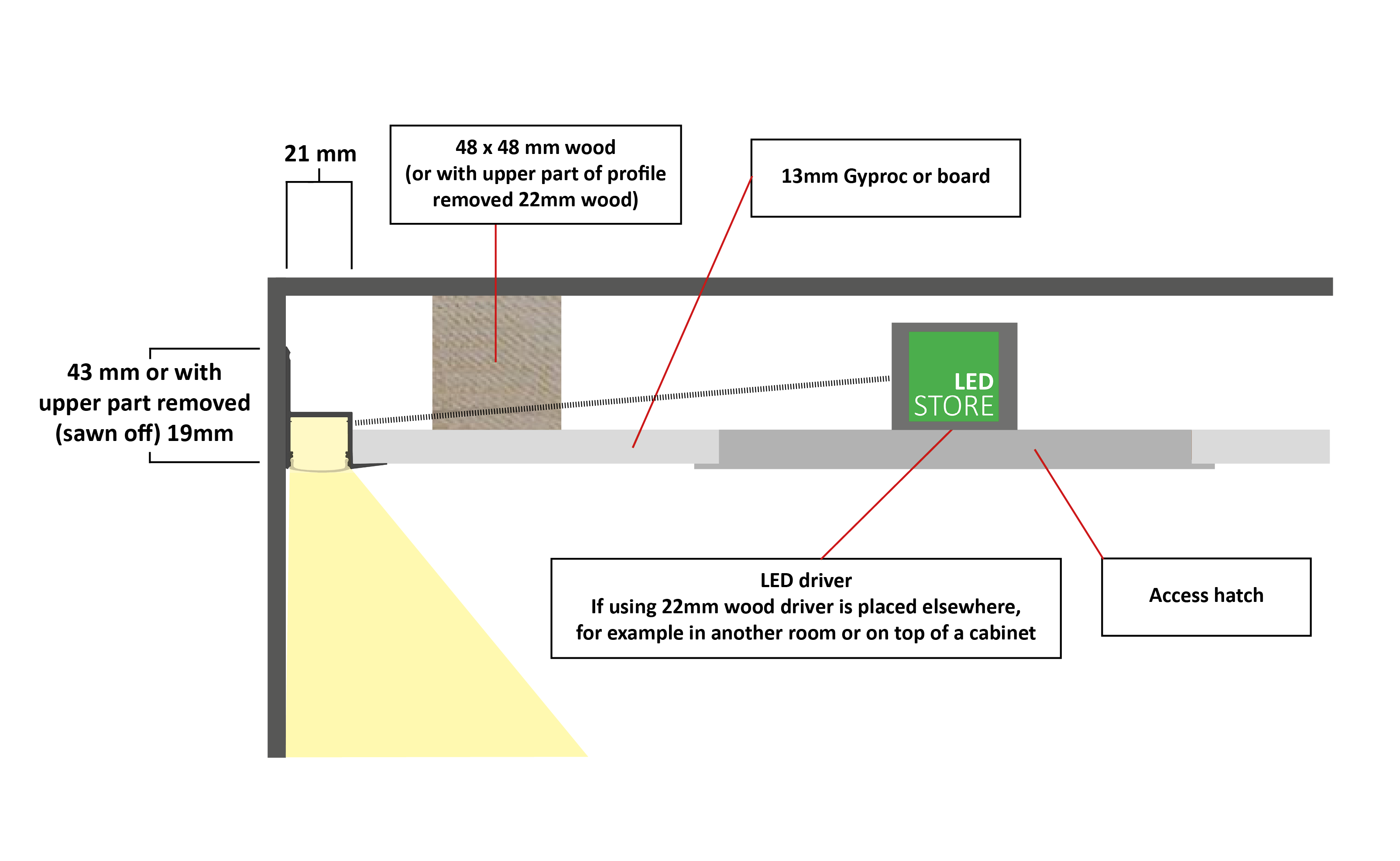
Strip at the back edge of the furniture or in the inside corner of the side panels, light onto the back panel or wall. The furniture glows from inside, objects stand out in silhouette. This is how a TV unit and a display cabinet are lit. A straight profile (if the lip is deep enough) or a 45° corner profile in the inside corner aims the light at the back, not at the viewer.
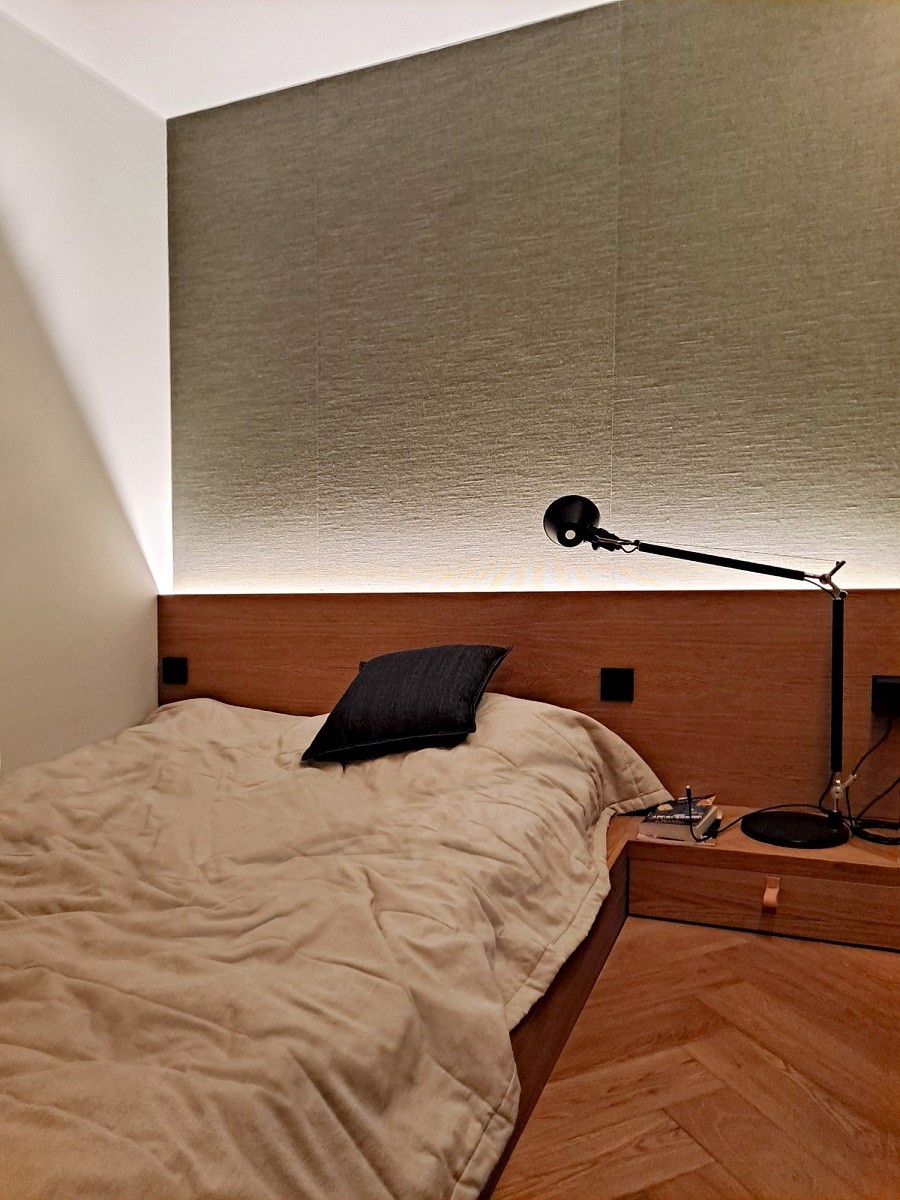
3. Kickboard and underside of a worktop – floating furniture
Strip behind the cabinet kickboard or under the worktop, light onto the floor. The furniture seems to lift off the floor. Works on TV units, kitchen and bathroom cabinets and hallway wardrobes. The cheapest furniture light, because the profile does not need to be neat – it is not visible.
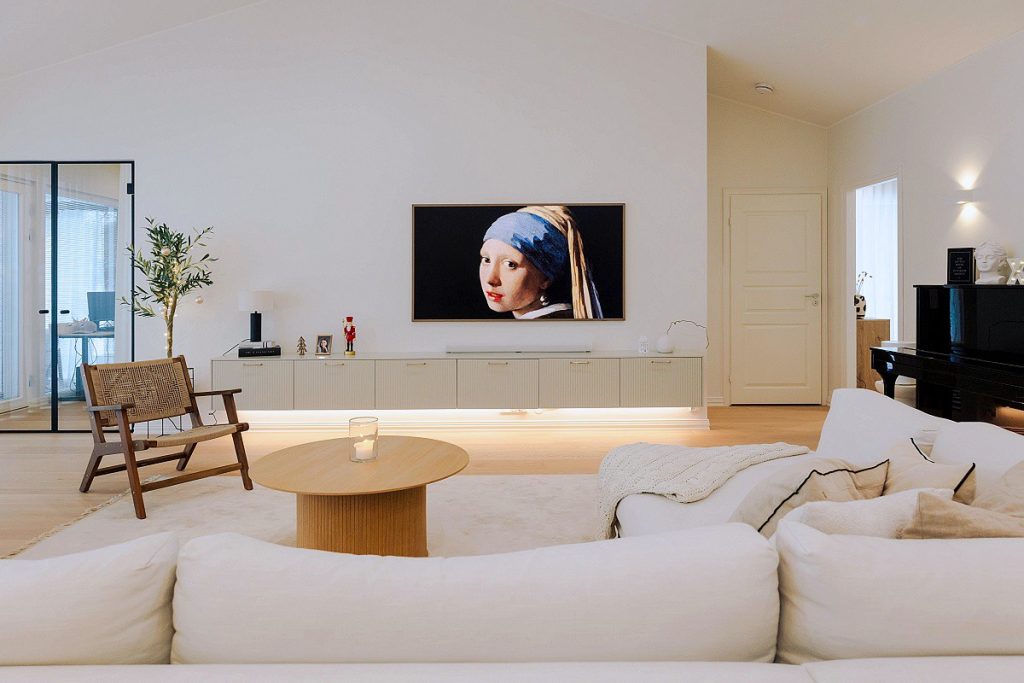
Sizing and choices
| Strip power | 3.6-7.2 W/m – accent light, not general light. 14.4 W/m only if the furniture is deep or dark |
| Strip type | COB essential – the viewer is close, SMD dots show on a glossy shelf and glass |
| CRI | 95-97 – books, objects and clothes look their true colour |
| Colour temperature | the same as the room’s general light – a different tone in furniture looks like a mistake |
| Strip width | 5 mm narrow strip for thin shelf profiles, 8-10 mm for kickboards |
| Profile | essential – cooling and a straight line. Without a profile the strip bends and sticks poorly |
Wardrobe and cooker hood – mind the heat
In a closed cabinet the heat cannot escape. A 7.2 W/m strip in an aluminium profile is safe, 14.4 W/m without a profile overheats and cuts its life by years. The same applies under a wall cabinet near the hob – a profile is essential.
Hide the cables – plan before assembly
The most common fault in furniture lighting is not the light but a cable hanging from the shelf edge. The cable route is planned before the furniture is assembled, because in a finished cabinet the hole has to be drilled where there is no room to drill.
- Driver behind or on top of the furniture, next to a socket. One driver is enough for one piece of furniture.
- 24 V supply cable from the driver to the back edge of the furniture in a cable duct or behind the back panel.
- An 8 mm hole at the back edge of each shelf, cable through it to the profile. The hole stays hidden behind the books.
- Strips wired in parallel to the driver, not in series – wiring in series leaves the lower shelves dim.
- Switch: a Zigbee battery button on the side of the furniture, or part of the room’s scene control.
Shop furniture lighting → · Kickboards → · COB or SMD →
Furniture profiles and narrow strips → LedStore
Frequently asked questions
How is an LED strip installed in furniture?
Three ways: at the front edge of the shelf with light down, at the back edge of the furniture with light to the back, or in the kickboard with light onto the floor. A recessed profile needs a 12 mm groove, a clip-on edge profile grips the board without routing.
How thick must a shelf be for an LED profile?
A recessed shelf profile needs a groove about 12 mm deep, so a 16 mm board is enough. A clip-on edge profile fits boards up to 17.5 mm thick without routing.
Which strip for furniture?
3.6-7.2 W/m and dot-free COB. In furniture the strip is seen close up, so dots would show immediately. A narrow 5 mm strip fits the thinnest profiles. CRI 95-97.
Can a display cabinet be lit with LED strip?
Yes, and CRI is decisive here. Below 95 the colours of objects look flat. In a display cabinet it pays to choose CRI 96-97 even though it costs more. In a closed cabinet a profile is essential because of heat.
How are furniture light cables hidden?
An 8 mm hole drilled at the back for each shelf and a cable duct behind the carcass. Plan the route before assembly – in a finished cabinet the hole has to be drilled where there is no room.
Does furniture lighting need an electrician?
No, if the driver has a plug. Furniture lighting is 24 V extra-low voltage and a DIY installation. A fixed connection to a wall box needs an electrician.
Toteutettuja kohteita
Epäsuora valo kalusteissa
Vaatehuone, hyllysyvennys, naulakko ja vitriini – upotettuja profiileja kalusteissa.
Kuvat: LedStore.fi toteutetuista kohteista.