
Rooms
Plinth lighting – floating cabinets and a night light
Strip behind the plinth board, light onto the floor – the cabinets lift off the floor and the room has a night light that does not wake anyone. The cheapest indirect light there is, and thanks to Zigbee it can be done in an existing kitchen in an afternoon.

What plinth lighting does
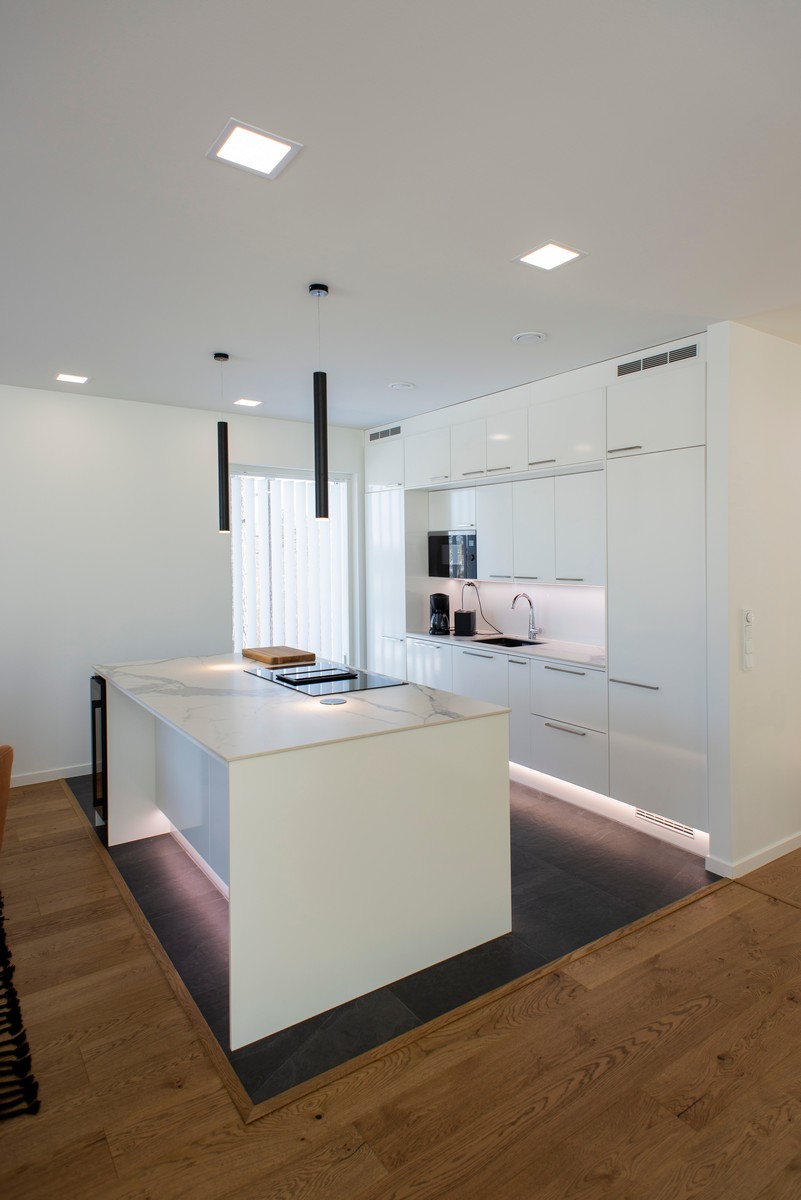
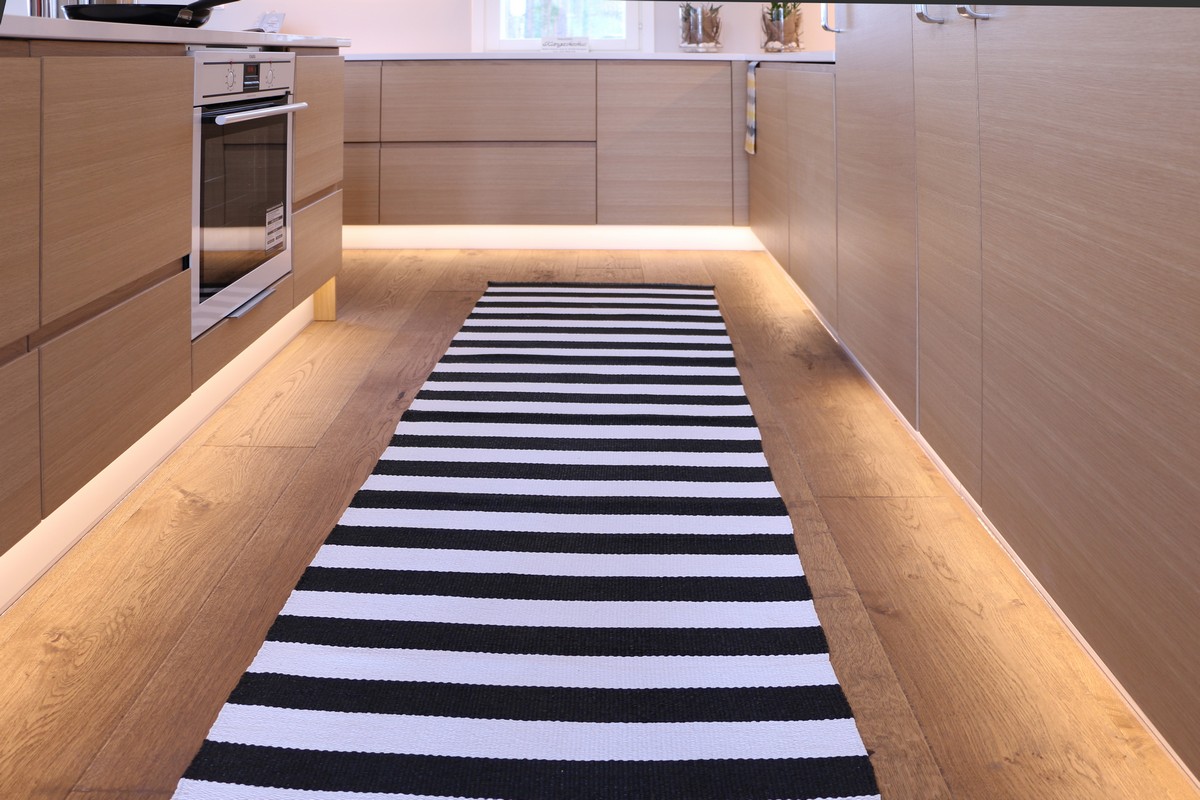
The plinth is the 10-15 cm board at the bottom of the cabinets between the floor and the cabinet. When an LED strip is placed behind it and the light is aimed at the floor, two things happen: the cabinets look as if they float – the floor beneath them glows and the cabinet lifts off it – and there is a dim light on the floor that is enough to see by at night without switching on the main light.
It is indirect light at its purest: the strip is completely hidden, only the lit surface is visible. And because the floor is close and the plinth hides the strip from every direction, there is no glare.
Where plinth lighting works
| Room | What it does | Special notes |
|---|---|---|
| Kitchen | Floating cabinets, a night light for a glass of water | IP65 – the floor is washed. Motion sensor. |
| Hallway | Cabinets float, light where the shoes are, night light from the door | Motion sensor: comes on when you walk in with your hands full |
| Bathroom | Vanity floats, night light for a WC trip | IP65 essential, driver outside the bathroom |
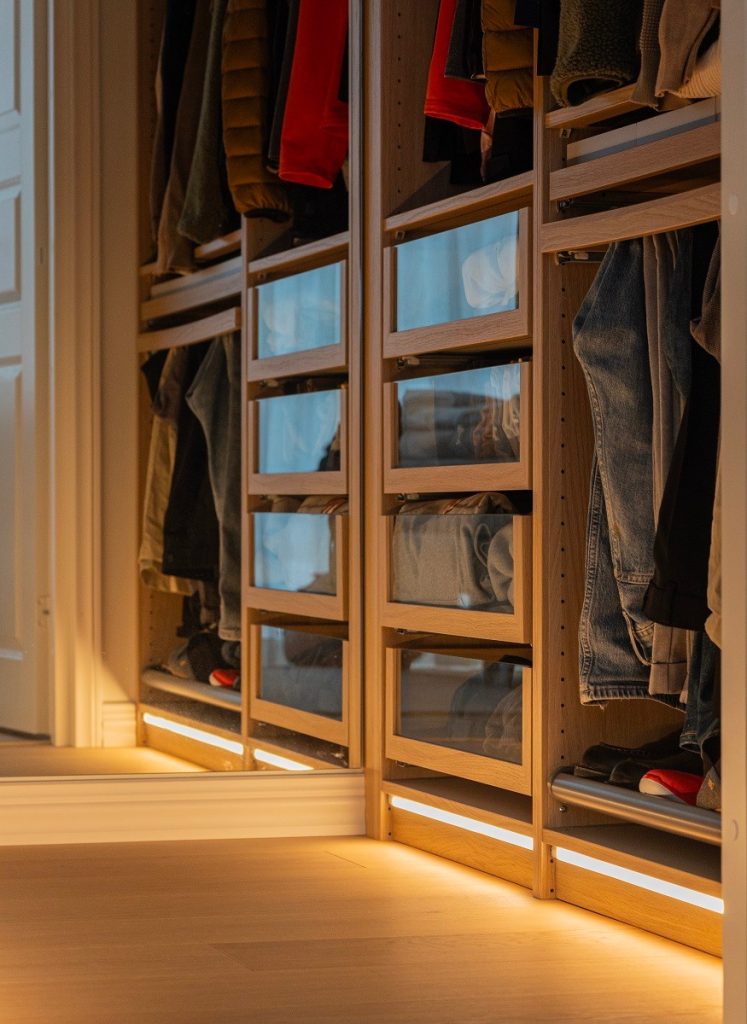
| Walk-in wardrobe | Cabinets float, you can see the shoes on the floor | Motion sensor at the door, light only when someone is inside |
| Living room, TV unit | The unit floats, mood light for a film | Its own group, dimming |
| Bed | The bed floats, a night light that does not wake you | Schedule: comes on only 23:00-06:00, 5 % |
| Shop, restaurant | Counter and fixtures float, guides circulation | Continuous base level, 7-year warranty |
How it is done
Plinth lighting is the simplest indirect light there is, because the plinth is already the glare shield and the profile does not need to be visible. Six steps:
- Remove the plinth board. It is usually clipped to the cabinet legs – pull from the bottom edge.
- Fix the profile to the carcass behind the cabinet legs or to the top edge of the inside of the plinth board, light down. A low surface profile or 45° corner profile. Screws or double-sided tape – tape is enough in a plinth, because there is no load.
- Stick the strip into the profile, with the cable into the cabinet next to one of the legs. There is room for the cable under the plinth.
- Driver inside the cabinet on the bottom shelf or next to the dishwasher. A Zigbee driver with a plug – there is always a socket in the sink cabinet.
- Motion sensor – Zigbee, battery-powered, on the inside of the plinth or the side of the cabinet. Setting: at night it comes on at 15 % for 2 minutes, during the day it does not react.
- Plinth board back on. Done.
In practice: L-shaped kitchen, plinth 2.4 + 1.8 m
4.2 m of strip at 7.2 W/m = 30 W. COB 8 mm IP65, because the floor is washed wet. Low surface profile 4.2 m. 36 W Zigbee driver in the sink cabinet socket. Zigbee motion sensor on the inside of the plinth. Materials: profile €60, strip €90, driver €70, sensor €30 – about €250. Work: 2 hours, no electrician. In the Zigbee app: movement at night → 15 % for 2 min, evening scene → 40 % permanently, off during the day.
Retrofit – why Zigbee changed this
Plinth lighting used to need an electrician: a switch in the wall, a cable behind the cabinet, a connection in a box. Now a Zigbee driver goes into the socket every kitchen already has in the sink cabinet, and the button or sensor is battery-powered and needs no cable. The whole installation is DIY in an existing kitchen – and if you move, you take it with you.
No switch at all
Plinth lighting is the light nobody switches on by hand. It comes on from movement at night, to a mood from an evening button, and goes off by itself. If you add a wall switch, it is either always on or always off. A Zigbee sensor and schedule do it right.
Sizing
| Strip power | 3.6-7.2 W/m – night light and mood, not general light. 14.4 W/m is too much in a plinth |
| Strip type | COB – a glossy tile or laminate floor reveals SMD dots as reflections |
| IP rating | IP65 kitchen, bathroom, hallway – the floor is washed wet. IP20 walk-in wardrobe, TV unit |
| Colour temperature | The same as the room’s other light. 2200-2700 K as a night light |
| Profile | Low surface profile or 45° corner. It does not need to be visible – the plinth hides it |
| Driver | Zigbee with a plug inside the cabinet. In a bathroom outside the cabinet |
| Control | Motion sensor 10-15 % at night, button 30-50 % for mood, no switch |
Three mistakes
- Strip too close to the floor. If the strip is at the bottom edge of the plinth, a bright band appears on the floor instead of a soft glow. Strip at the top edge of the plinth, 10-15 cm from the floor, so the light spreads.
- SMD on a glossy floor. Tile and laminate mirror, and the row of dots shows as a reflection. COB.
- IP20 in a kitchen. The floor is mopped, and water splashes behind the plinth. IP65 strip and joints inside the cabinet in the dry.
Kitchen – three places for a strip → · Hallway → · Furniture → · Dimming and control →
Plinth lighting → LedStore
Frequently asked questions
How is plinth lighting installed?
Remove the plinth board, fix a low profile to the top edge of its inside with light down, strip into the profile, cable into the cabinet, Zigbee driver into the sink cabinet socket, motion sensor on the plinth, board back on. Two hours, no electrician.
Which strip for plinth lighting?
COB 7.2 W/m IP65. COB because a glossy floor reveals dots as reflections, IP65 because the floor is washed wet. 14.4 W/m is too much in a plinth.
Can plinth lighting be installed in an existing kitchen?
Yes, and that is the most common case for plinth lighting. The Zigbee driver goes into the sink cabinet socket, the sensor is battery-powered – no wiring, no electrician.
Is plinth lighting worth it in a kitchen?
Yes. The cabinets look as if they float and the floor light is enough for a night-time trip without the main light. €250 and an afternoon.
Is plinth lighting visible during the day?
Not really – it is lost in daylight. Plinth lighting is an evening and night light. That is why it is not sized as general light or switched on from a switch, but from a sensor and schedule.
How is plinth lighting controlled?
Zigbee motion sensor: at night movement switches it on at 15 % for two minutes. Evening button: 40 % for mood. During the day it does not react. A wall switch is not worth it – it stays always on or always off.
Toteutettuja kohteita
Sokkelivalaistus toteutettuna
Nauha kalusteen tai keittiösaarekkeen sokkelin taakse – kaluste näyttää kelluvan ja lattia saa pehmeän yövalon.
Kuvat: LedStore.fi toteutetuista kohteista.